
Operations exceptions
Collect missing context, apply the right rule, route work to an owner, and leave a decision record when the case cannot safely proceed.
AI workflow automation
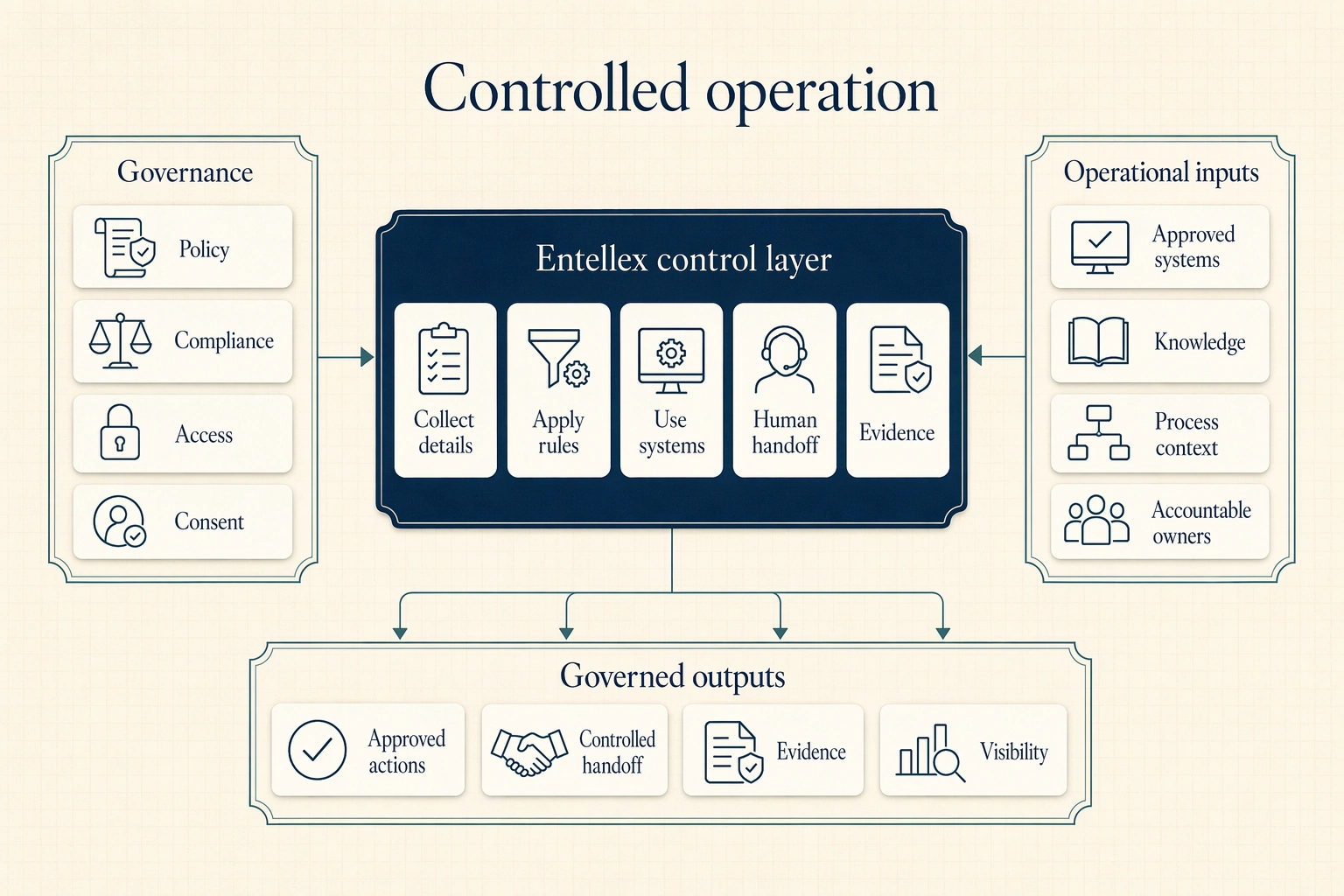
Entellex turns requests into controlled workflow progress: collect the right details, apply rules, use approved systems, stop for human judgment, and keep the outcome reviewable.
From request to outcome
A fluent AI response does not complete business work. The operation needs context, policy, system boundaries, ownership, monitoring, and evidence around every meaningful step.
The controlled sequence
Pause the work and collect the required detail before the next action can move forward.
Use the policy, approval path, or risk boundary that governs this particular operation.
Use scoped lookups and writebacks rather than broad, uncontrolled system access.
Stop and hand off when the data, decision, authority, or exception requires accountable judgment.
Preserve the action, boundary, owner, and result for operations and review teams.
Where AI workflow automation fits
Collect missing context, apply the right rule, route work to an owner, and leave a decision record when the case cannot safely proceed.
Move an inquiry from intake through approved knowledge, required details, system lookup, human handoff, and a reviewable outcome.
Use scoped access to approved records and system actions when the business needs more than a recommended answer.
The best first workflow has a meaningful business outcome, a known owner, defined exception conditions, and a limited set of approved actions. It does not require claims of unattended autonomy.
Evaluation checklist
Approved system action
This proof shows AI using a scoped source-system operation while keeping allowed fields and denied scope visible. That is the distinction between a task response and governed workflow progress.
Open the proof momentBuild the operating model
First operation
Bring the business outcome, required context, approved systems, exception owner, and evidence needed to review the result.
Request an operation review