
Trust and evaluation
Know what to review before AI goes live.
Start with the proposed operation and its controls. Security, privacy, access, deployment, retention, and vendor-review questions should be answered for that scope—not assumed from generic public claims.
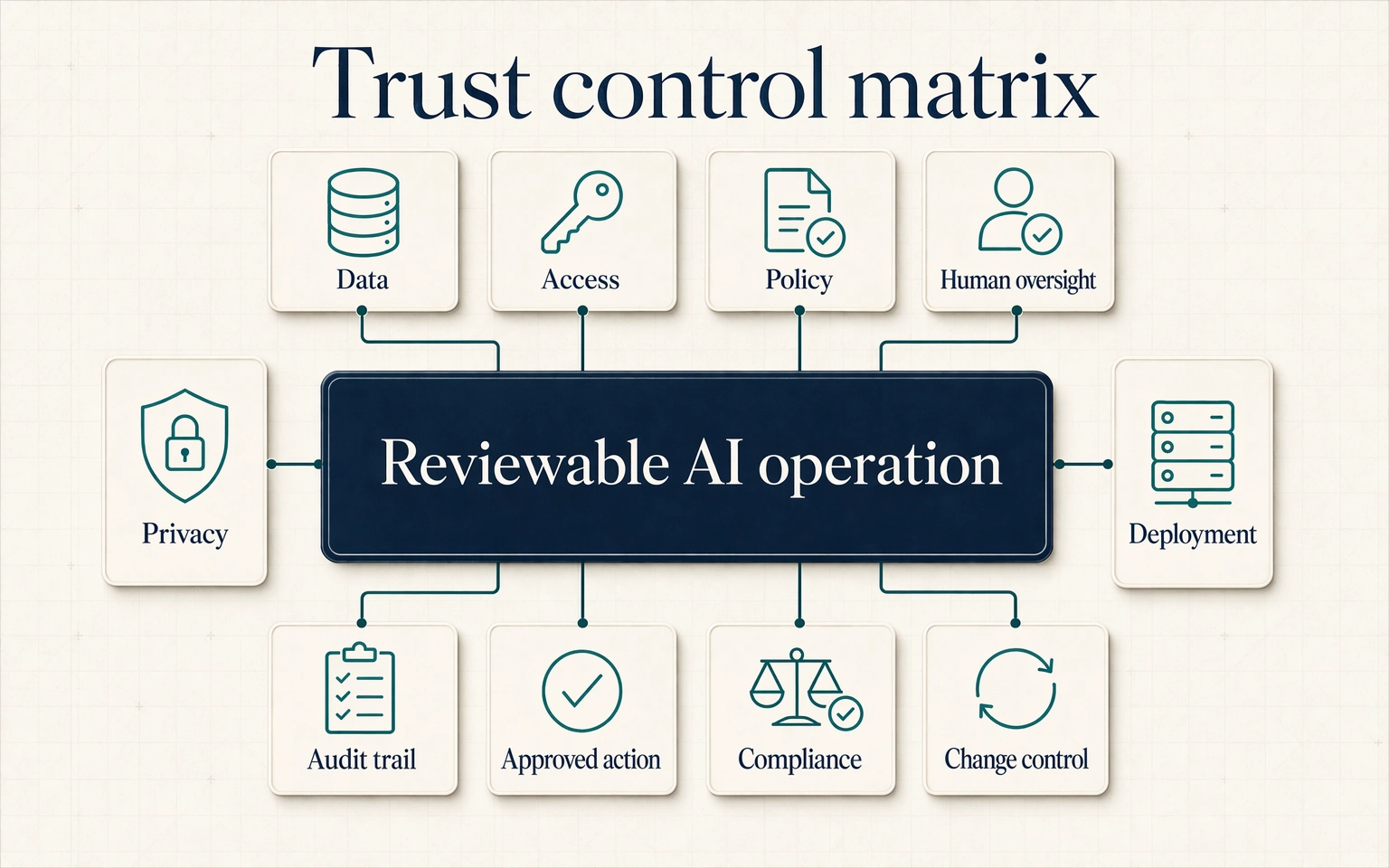
Start with the operation
A useful review makes four things visible.
Before a technical review can be meaningful, the operation itself needs a defined outcome, boundary, owner, and evidence requirement.
- 01
The work
What outcome the operation is expected to move forward.
- 02
The boundary
Which steps may proceed, and where the operation must stop.
- 03
The owner
Who takes responsibility when the operation needs a person.
- 04
The evidence
What the business needs to inspect after the outcome.
Public starting material
Understand the public model.
These pages show how Entellex frames controlled AI work. They are a starting point for evaluation, not a substitute for scope-specific review material.
During evaluation
Request material for your scope.
There is no universal deployment or compliance answer that is honest for every customer. The relevant answers should be tied to the proposed operation, environment, and review process.
- Architecture and deployment
- Discuss the proposed environment, approved systems, responsibilities, and rollout approach for the operation.
- Identity and access
- Review the roles, access boundary, and system permissions the scoped operation needs.
- Data handling and retention
- Review data use, storage, retention, and deletion expectations for the proposed scope.
- Security, privacy, and vendor review
- Request the security, privacy, legal, or third-party review material that applies to your evaluation.
- Operational assurance
- Review human handoff, change process, monitoring, and the evidence the team expects to inspect.
This public site does not declare a certification, attestation, universal deployment model, retention term, or integration catalogue.
Scoped review
Bring the review question.
Start with the operation, environment, teams involved, and evidence your organization needs to assess.
Start an evaluation conversation