ResolveDesk AI

AI contact-center automation without forcing a rip-and-replace of the existing stack.

ResolveDesk resolves approved repetitive support operations before they reach agents, then escalates complex cases with context.

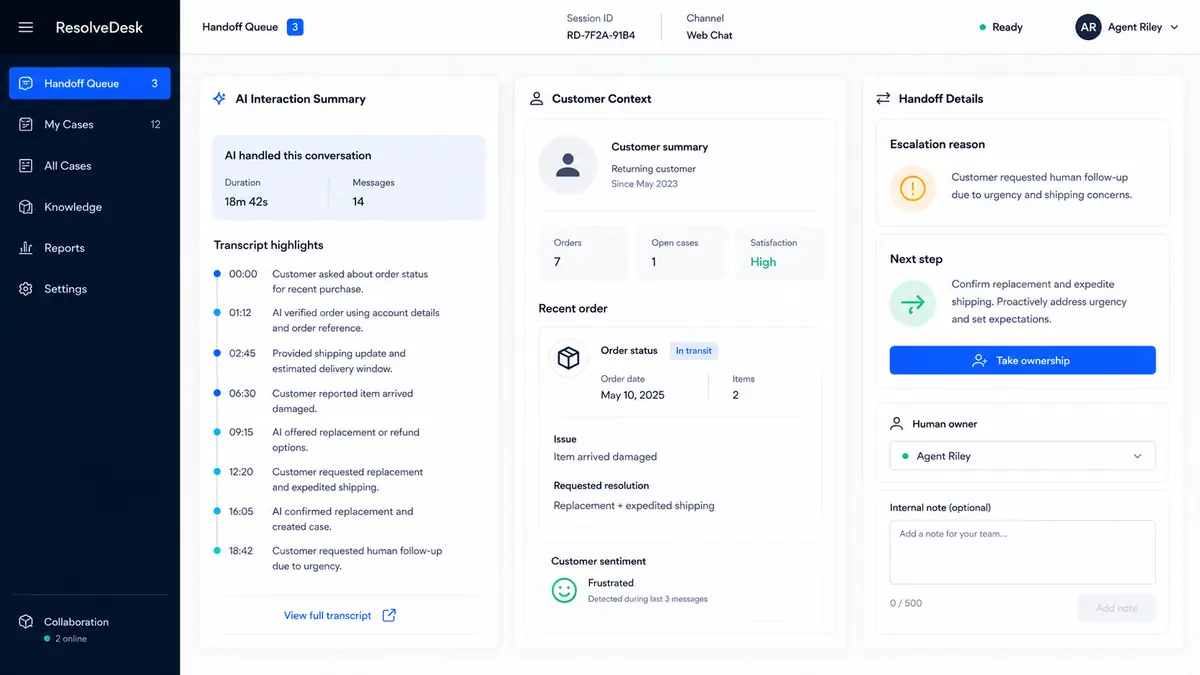
ResolveDesk handoff interface showing customer context, evidence, escalation reason, owner, and next action.

Where ResolveDesk fits

ResolveDesk surrounds the existing support stack instead of asking teams to replace it first.

ResolveDesk handles approved status checks, intake, FAQs, routing, ticket updates, and handoff packages around CRM, ticketing, telephony, and contact-center platforms. Human teams keep judgment, empathy, and exception ownership.

Existing-stack fit

ResolveDesk should be evaluated around the systems and queues your support operation already uses.

The first question is not whether to replace the support stack. It is which repetitive operations can be resolved or packaged for human takeover around the stack already in place.

Contact-center stack

Voice, chat, and agent platform

ResolveDesk can sit around Genesys, NICE, Five9, Talkdesk, Amazon Connect, Cisco, or other contact-center paths where integration scope allows.

  • Receives or routes support interactions.
  • Preserves transcript and channel context.
  • Escalates to agents with a packaged next step.
Case systems

CRM, ticketing, and service desk

The product can create, update, summarize, or route cases where approved, while the source of record stays in the client system.

  • Zendesk, Salesforce, Freshdesk, ServiceNow, Dynamics, or custom systems.
  • Approved read/write operations only.
  • Clear owner for unresolved cases.
Business systems

Status, payment, order, booking, or application data

ResolveDesk becomes valuable when it can retrieve approved status or operation context instead of only answering FAQs.

  • Order, payment, appointment, application, account, or service status.
  • No broad autonomy.
  • Fallback when source data is missing.

Scope clarity

Keep the contact-center stack. Automate the repetitive operation layer around it.

ResolveDesk is strongest when the first scope is narrow enough to review: a small set of repetitive requests, approved system lookups, clear escalation triggers, and measurable support outcomes.

Not a CCaaS replacement

Genesys, NICE, Five9, Talkdesk, Amazon Connect, Zendesk, Salesforce, ServiceNow, or Freshdesk can remain the operating stack where that is the right architecture.

Not a ticketing replacement

ResolveDesk can create, update, or summarize cases where approved. The source of record and ownership model stay inside the client support environment.

Not an uncontrolled AI agent

Sensitive, regulated, emotional, high-value, or unclear cases are blocked or escalated with transcript, summary, reason, and recommended next step.

Not a generic FAQ bot

The product value comes from approved operation resolution, scoped system access, handoff quality, and dashboard visibility.

Operation examples

Start with support operations that are high-volume, measurable, and safe to scope.

Retail and F&B

Order status, delivery ETA, returns, refund status, product availability, store information, complaints, and escalation.

Finance and payments

Transaction status, refund updates, complaint registration, device support, KYC guidance, and high-risk escalation.

Healthcare access

Appointment booking, rescheduling, reminders, location, billing FAQs, and escalation for clinical or urgent questions.

Government services

Service guidance, document requirements, application status, appointments, payments, complaints, and citizen-service handoff.

Pilot path

The first ResolveDesk pilot should prove resolution quality before expanding channels.

Start with repetitive work that already has a clear policy, a source of truth, a human owner, and measurable support load.

  1. 01

    Select operations

    Choose the top repetitive requests: status checks, refund updates, appointment changes, complaint intake, or ticket routing.

  2. 02

    Map systems

    Define which CRM, ticketing, telephony, order, payment, or scheduling operations ResolveDesk may use.

  3. 03

    Set boundaries

    Approve what AI can answer, collect, update, refuse, and escalate before production traffic.

  4. 04

    Package handoff

    Give agents the transcript, customer context, escalation reason, risk signal, and recommended next action.

  5. 05

    Measure outcomes

    Track resolved requests, escalations, repeat contact, blocked actions, agent takeover time, and customer friction.

Handoff packet

When ResolveDesk escalates, the agent should not start from zero.

Request Support issue Context Customer and case Boundary Escalation reason Owner Agent queue Proof Next action
Customer context
Identity context where approved, account or case references, channel history, issue summary, sentiment signal, and urgency marker.
Operation evidence
Intent, questions asked, information collected, approved sources retrieved, system status checked, and actions already completed.
Escalation reason
Low confidence, policy boundary, complaint, regulated issue, emotional tone, high-value customer, missing data, or human approval requirement.
Recommended next action
Agent takeover step, suggested response path, pending system action, owner, and any SLA or priority notes.

AI handles the repetitive layer. Humans own judgment, empathy, and exception handling.

The product is strongest when scoped around measurable repetitive operations, clear escalation rules, and support leaders who want better customer experience without losing control.

Discuss whether ResolveDesk fits your support operations.

Bring the support operations, systems, escalation rules, and current stack. The next step is a fit review, not a rip-and-replace decision.

FAQ

Common questions.

Does ResolveDesk replace our contact-center platform?

No. ResolveDesk is positioned as an operation-resolution layer around existing support stacks. Replacement is not the starting assumption.

What should the first pilot include?

A small set of approved repetitive operations, source-system access boundaries, escalation triggers, handoff format, dashboard metrics, and support-owner review.

What stays with human agents?

Judgment, empathy, regulated decisions, sensitive cases, exception handling, supervisor review, and final ownership remain with accountable teams.