Operations
Owns the outcome, workflow, exception path, and usable handoff.
Compliance and governance implementation
Entellex helps organizations translate policy, data, system, authority, and evidence decisions into controls that work inside real AI operations.
The leadership question
The question is whether the organization can govern what happens next: what information AI may use, which action it may take, who owns an exception, and what evidence remains.
The boundary of the work
What business outcome may AI move forward—and which decisions remain explicitly out of scope?
What data may enter the operation, and which approved records and systems may it reach?
When must the operation pause, escalate, or ask for approval—and who owns the next decision?
What needs to remain visible after an important action, exception, or change?
What tools do not solve
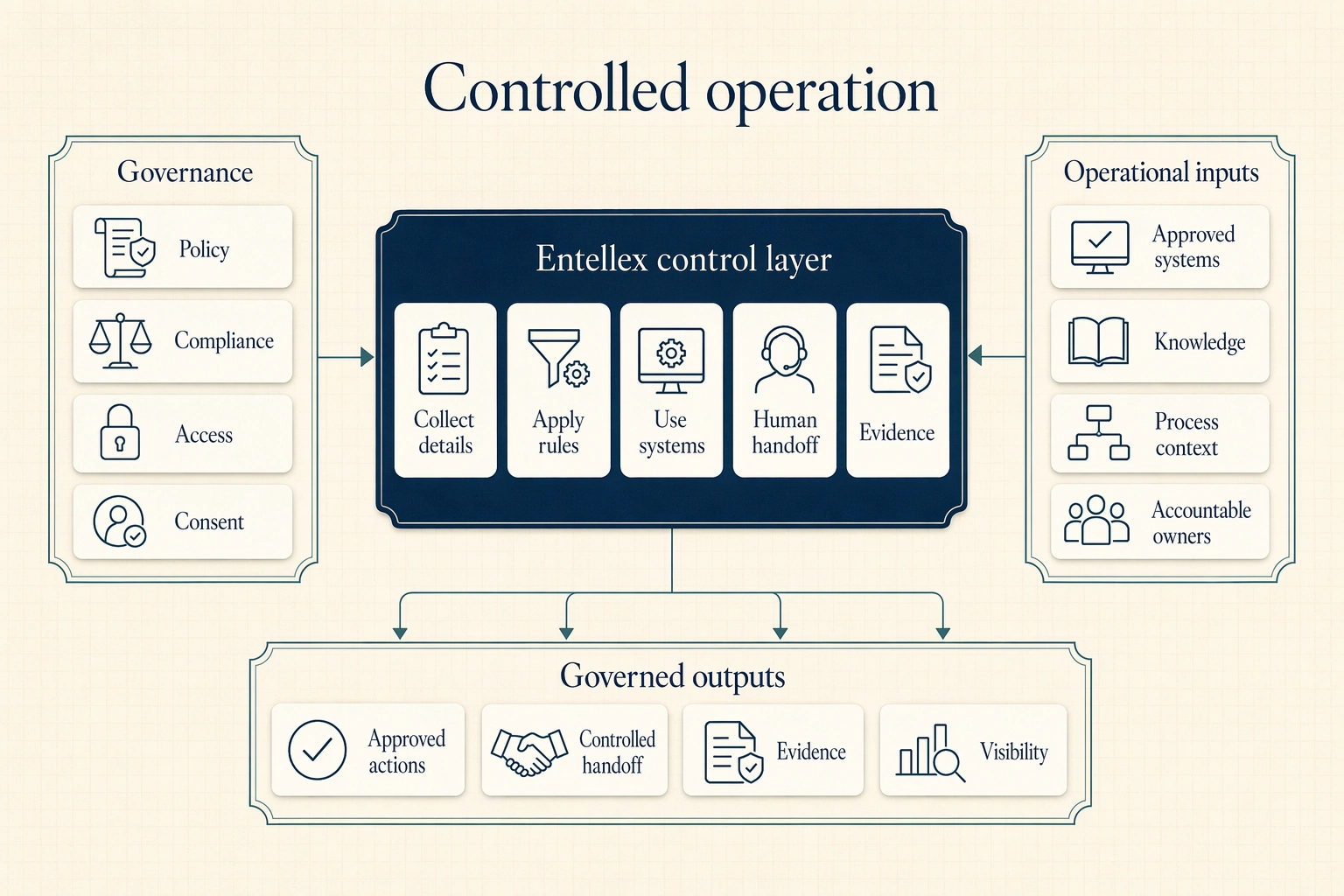
The operating question is how policy changes a workflow: how data and permissions shape actions, where human authority takes over, and what the organization can later explain.
The operating layer
Translate obligations into boundaries for what AI may say, collect, retrieve, update, refuse, or route in this operation.
Connect AI to scoped business-system actions, confirmations, and human approvals rather than broad autonomy.
Make decisions, actions, blocks, handoffs, and outcomes reviewable by the teams accountable for the operation.
One decision model, several owners
Owns the outcome, workflow, exception path, and usable handoff.
Own the obligation, policy interpretation, data boundary, and evidence need.
Own the identity, integration, access, deployment, and change assumptions.
As the estate grows
The first deployment should create a reusable foundation, but reuse is earned by matching conditions—not assumed because two use cases share a model.
Enterprise controls can carry forward where data, risk, ownership, and system boundaries genuinely match.
A product, workflow, or operation that changes the risk posture needs its own explicit review.
New data, integrations, actions, policies, or operating assumptions should not quietly change what AI is permitted to do.
Framework alignment
Entellex can map controls to the requirements of an agreed scope. Certification, legal interpretation, and compliance determinations remain client-specific and require qualified review.
Start with the decision that matters
What business outcome should AI be allowed to move forward?
Where do data, system action, or decision-making create meaningful risk?
Who owns the exception when the operation should not proceed?
What must leadership be able to inspect before expanding the scope?
Compliance and governance implementation
Bring the AI work, the policy question, the connected systems, and the evidence your organization needs to inspect.