
Repeated reviews
Every new tool repeats policy, privacy, security, and operating review.
A resource on AI tool sprawl
It begins when separate AI products and agents each create their own path for access, review, escalation, and evidence. The visible issue is a growing tool list. The operating issue is that the same decisions must be made again and again.
What the teams feel
Every new tool repeats policy, privacy, security, and operating review.
Similar work follows different approval and authority boundaries.
Product-by-product access reviews obscure what can be reused.
Reviewers must piece together the request, control, owner, action, and outcome.
A shared control layer
A shared operating layer gives each approved product or AI workflow a consistent way to apply the organization’s policy boundaries, approved actions, ownership, and evidence requirements.
It does not claim to discover every unsanctioned AI tool across the enterprise. It creates a controlled path for the products and operations the organization chooses to govern.
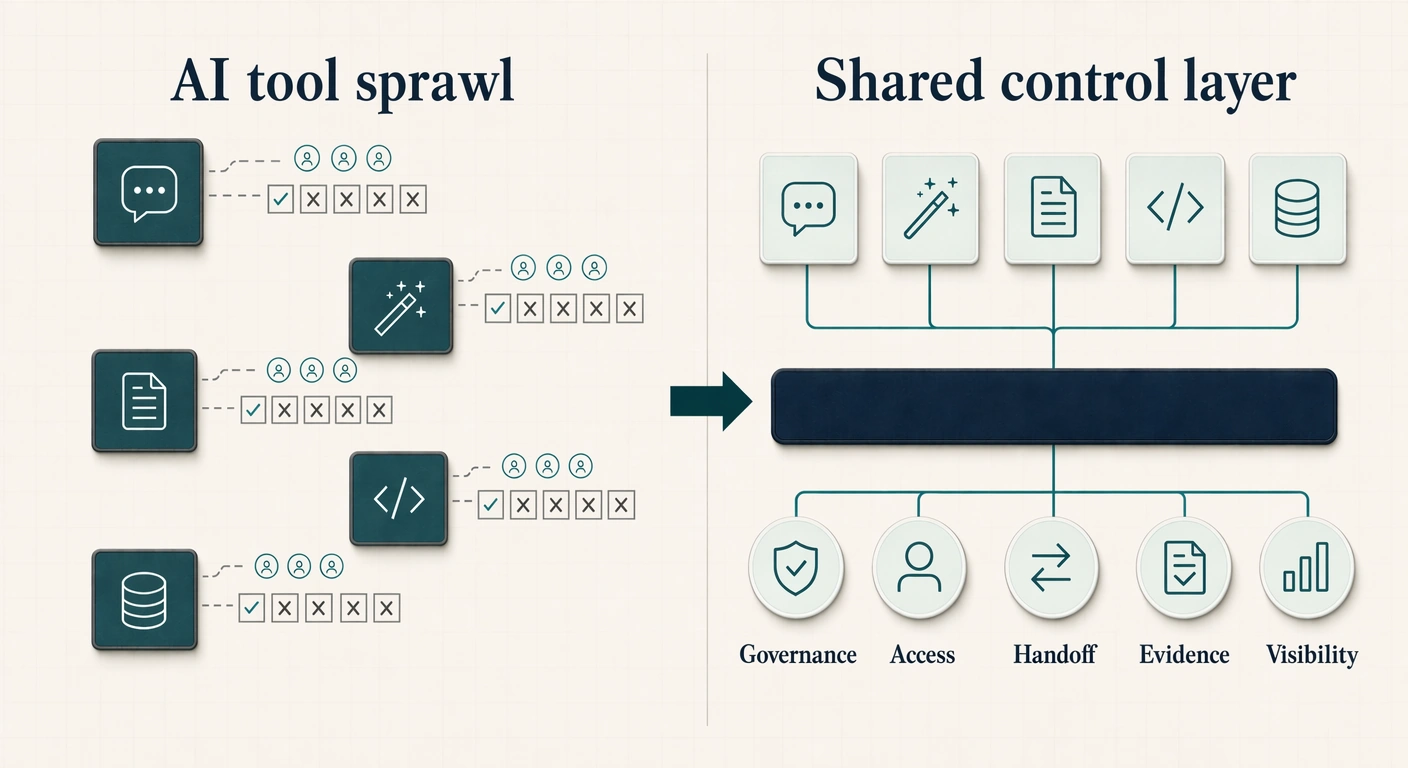
How AI sprawl shows up
Related workflows use separate products, rebuilding review, access, escalation, and evidence.
Similar agents use different action boundaries, permissions, handoffs, and evidence.
One review requires teams to piece together the request, control, owner, action, and outcome.
A practical review
Start with the decision or workflow that touches customers, employees, money, regulated information, or a source system.
Make the human authority model explicit, then apply it wherever that kind of work appears.
Keep the request, boundary, action, handoff, owner, and outcome reviewable when it matters.
What a shared layer changes
Policy boundaries, approval patterns, allowed actions, ownership models, and evidence requirements.
The outcome, workflow context, source systems, success measures, exceptions, and accountable operator.
Entellex governs the work put through its operating layer; it does not claim to discover or manage every AI tool in an enterprise.
Common questions
Continue from the problem
First operation
Bring one operation, the teams reviewing it, the systems it can touch, and the evidence it must leave behind.
Request an operation review